American Tourister Luggage Review: Worth the Premium in India?
Most Indian travellers meet American Tourister the same way — as the bright hard-shell trolley on the airport belt, the bag a cousin bought before a Goa trip, the brand with the gorilla-tough reputation and the Cristiano Ronaldo commercials. By sheer volume it is one of the two or three names that shape what an Indian household imagines a “good suitcase” to be. What far fewer buyers stop to notice is exactly where the brand sits: American Tourister is Samsonite’s younger, cheaper, more colourful sibling — the mass-to-mid line in a house that also owns the premium Samsonite name.
This review answers the question the marketing carefully steps around. American Tourister costs more than Safari or Nasher Miles, but less than Samsonite or Mokobara. So when you pay that middle price, what are you actually buying — a better bag, or a better badge? We look at the polypropylene hardside trolleys that make up most of AT’s India sales, the materials they’re built from, the warranty, and whether the premium over budget Indian brands is money well spent.
The short answer: American Tourister is a genuinely reliable, well-made, lightweight hardside trolley for the traveller who flies a few times a year. It hands you Samsonite factory and quality control at a lower price, in far more colours. But it is not a premium product — the shells are polypropylene, not polycarbonate, and the India warranty is shorter than most rivals. The “premium” you pay over Safari is really for design, colour, and the Samsonite pedigree, not for better materials.
KEY TAKEAWAYS
- American Tourister was founded in 1933 in Providence, Rhode Island by Sol Koffler; it was folded into the Samsonite group in 1993 and today is priced a clear tier below Samsonite.
- In India, both American Tourister and Samsonite are made by Samsonite South Asia at the same Nashik plant — AT effectively gets Samsonite’s QA bar at a lower price point.
- The hardside range is mostly polypropylene — light and flexible, but not the premium polycarbonate class. The Airconic line is among the lightest hardsides sold in India.
- India warranty is typically a 3-year global warranty on hardside luggage (duration varies by line and is printed on the card inside the bag) — shorter than Safari/Skybags (5 yrs), Mokobara (6), and Samsonite (up to 10).
- The “premium” is really a brand-and-design premium over Safari and Aristocrat — not a materials or warranty premium.
1. American Tourister: The Dollar Suitcase That Became a Global Giant
American Tourister began in 1933, when Sol Koffler put his life savings into a tiny luggage business in a vacant grocery store in Providence, Rhode Island. His ambition was modest and specific: a hard-wearing suitcase durable enough to matter, cheap enough that anyone could buy one — the first sold for a dollar. Five thousand went out the door in year one, with Koffler as the company’s only employee. He adapted machinery built to bend plywood radio cases, simplified the suitcase, and named the durable line American Tourister.
Over the next decades the brand rode the rise of air travel, pioneering moulded plastic and vinyl cases and building one of the most recognised advertising campaigns in luggage history. In 1993 American Tourister was acquired by Astrum International — the group that also owned Samsonite — which was renamed the Samsonite Corporation two years later. That is the arrangement that still defines the brand: American Tourister is a Samsonite-owned label, deliberately priced below the flagship, aimed at younger and more price-sensitive travellers.
In India, this pedigree is more than trivia. American Tourister and Samsonite are both sold and serviced through Samsonite South Asia Pvt. Ltd., and India-market bags for both brands roll off the same manufacturing base in Nashik, Maharashtra. The same engineering team, the same QA standards, and the same service network sit behind an AT trolley and a Samsonite one — the difference is the materials budget, the features, and the price. American Tourister leans youthful and colour-forward, with a bestseller list built around the Airconic, Curio, Circurity+, Sky, and Spinn hardside lines, and it signed Cristiano Ronaldo as a global brand ambassador in 2018.
FUN FACT: For decades, American Tourister’s most famous advertisement showed a gorilla jumping on, hurling, and stomping a suitcase inside its zoo cage — and the bag surviving. The “gorilla-proof” campaign ran for years and became shorthand for the brand’s whole pitch: luggage tough enough to take a beating. It remains one of the most recognised ad campaigns the luggage industry has ever produced.
2. Understanding American Tourister’s Place in the Samsonite Family
The single most useful thing to understand before buying is the house of brands. Samsonite International runs a ladder of labels at different price points — Tumi and Samsonite at the premium and mid-premium end, American Tourister at mass-to-mid, and others like High Sierra and Lipault elsewhere. In the Indian market the pair that matters is Samsonite and American Tourister, and the relationship is best thought of the way Toyota relates to Lexus: shared engineering and factories, genuinely different materials budgets and target buyers.
Practically, that means an American Tourister bag is not a “cheap knock-off” of a Samsonite — it is a real Samsonite-group product built to a lower cost target. You feel the shared parentage in the zipper action, the wheel roll, and the handle finish, all of which are a step above pure-budget brands. Where AT is deliberately held back is in shell material (polypropylene rather than polycarbonate on most models), interior organisation, and warranty length. Here is how the India range breaks down.
| Range | Type | Material | Best For | Price Band (sale) |
|---|---|---|---|---|
| Airconic 2.0 | Hardside cabin / check-in | Polypropylene | Lightweight air travel, frequent cabin use | ₹5,000–₹9,000 |
| Circurity+ / Kross+ | Hardside spinner | Polypropylene | Colour-forward cabin, young buyers | ₹4,500–₹8,000 |
| Skytrac | Hardside spinner | Polypropylene | Budget entry hardside | ₹3,000–₹6,000 |
| Backpacks | Casual / laptop backpack | Polyester | College, commute, gym, weekend | ₹1,200–₹3,500 |
Prices listed are indicative and were accurate at the time of research. Luggage and bag prices fluctuate frequently due to sales, festive discounts, and MRP-vs-street-price gaps, so actual prices at the time of your purchase may differ from what’s listed here. Always verify current pricing on the retailer’s website before buying.
3. The Hardside Trolleys: Where American Tourister Actually Competes
The hard-shell trolley is American Tourister’s heartland in India, and it is where the brand is genuinely competitive. The Airconic, Curio, Circurity+, Sky, and Spinn lines cover cabin through large check-in sizes, and for the occasional-to-moderate traveller they do the job well: they look good, they’re light, and they carry the reassurance of the Samsonite service network behind them.
Materials and construction
Most American Tourister hardside bags are moulded from polypropylene, a light, flexible plastic that absorbs impact by flexing rather than shattering, and whose textured finishes hide scuffs and belt marks well. The trade-off is that PP is not as rigid or as scratch-and-crack resistant over years of rough handling as good polycarbonate — it is a lighter, cheaper material class. The Airconic line leans into that lightness: its large spinner weighs in around 3.2 kg, and cabin sizes sit near 2.4 kg, putting it among the lightest hardsides you can buy in India.
The hardware is where the Samsonite parentage shows. You generally get dual or single spinner wheels that roll smoothly, telescopic handles with a solid click, a TSA-approved combination lock on many (not all) models, a zip expander for extra capacity, and simple but sensible interiors — a full zip divider, cross straps, and a mesh pocket. What you do not get, and should not expect at this tier, is premium interior organisation, USB pass-throughs, or laptop compartments in the trolleys. The softside range switches to polyester, with some pieces using Recyclex, a fabric spun from recycled PET bottles.
What the warranty actually covers
American Tourister’s India hardside luggage typically carries a 3-year global warranty, though the exact duration varies by product line and is printed on the warranty card inside each bag (some global markets advertise longer terms). It covers manufacturing defects in materials and workmanship only. It explicitly does not cover normal wear and tear, misuse, accidental damage, or — crucially — airline and transit damage, which is the most common way luggage actually gets hurt. Claims run through Samsonite-approved service centres, and because AT rides the Samsonite network, service coverage is genuinely global, though fastest in the metros. It is worth being clear-eyed here: three years is the shortest warranty in its competitive set — Safari and Skybags offer five, Mokobara six, and Samsonite up to ten.
4. The “Premium” Question: What You’re Actually Paying For
This is the crux of the review. American Tourister sits in the middle of the Indian luggage market — above the budget tier of Safari, Aristocrat, and Nasher Miles, and below the mid-premium tier of Samsonite and design-led Mokobara. Buying AT means paying a premium over the cheapest option. The honest question is what that premium buys, and what it doesn’t.
What the premium does buy: Samsonite’s engineering and quality control (you feel it in the wheels, zippers, and handles), noticeably light polypropylene shells, a far wider range of colours and licensed collaborations, real brand trust and gift/resale value, and access to a global service network. For a lot of Indian buyers, that combination is exactly what they want in a suitcase.
What it does not buy: premium materials (you’re getting polypropylene, not the polycarbonate that Samsonite and Mokobara use at higher tiers), a long warranty (three years is the category’s shortest), premium interior organisation, or TSA locks as standard across every model. If those are your priorities, the money is better spent one tier up.
THE REAL PICTURE: The polypropylene-versus-polycarbonate distinction decides whether the premium is “worth it” for you. PP is lighter and flexes under impact, which suits a bag that flies two to four times a year and spends most of its life in a cupboard — for that traveller, American Tourister is a smart, sensible buy that will last for years. But under weekly rough handling, PP fatigues, scratches, and can crack sooner than a good polycarbonate shell. If you are a frequent flyer who checks bags on every trip, a polycarbonate Samsonite or Mokobara will outlast an AT and justify its higher price. The premium over Safari is real, but it is modest and mostly buys you pedigree, lightness, and looks — not a fundamentally tougher shell.
5. Who Should Buy American Tourister
-
Buy it if: you fly a few times a year, want a light hardside that looks good on the belt, value the Samsonite QA bar and a global service network, and like having real colour and design choice. This is the sensible default suitcase for most Indian households.
-
Consider stepping up if: you are a frequent flyer who checks bags often. A polycarbonate Samsonite or Mokobara will survive rough handling longer and carry a much longer warranty, which changes the cost-per-trip math in its favour.
-
Consider stepping down if: raw value-per-rupee is the priority. Safari’s hardside range gives you more bags for the money, and for occasional use the gap in feel is smaller than the gap in price.
-
Not ideal if: you want premium interior organisation and design-led silhouettes (look at Mokobara), or you specifically need the longest warranty in the category.
6. Verdict
American Tourister is the Maruti of Indian luggage — the safe, sensible, slightly more than the cheapest default that a huge number of buyers will be perfectly happy with. It earns that position honestly: real Samsonite pedigree, light polypropylene shells, smooth hardware, and a genuinely wide colour and design range. For the occasional traveller who wants a good-looking, reliable bag and the reassurance of a global service network, it is worth the modest premium over Safari.
But “premium” is the wrong word for what this brand is. American Tourister is a well-run mass-to-mid label, not a premium one. If you want premium materials or the longest protection, your rupees go further at Samsonite or Mokobara; if you want maximum value, Safari wins.
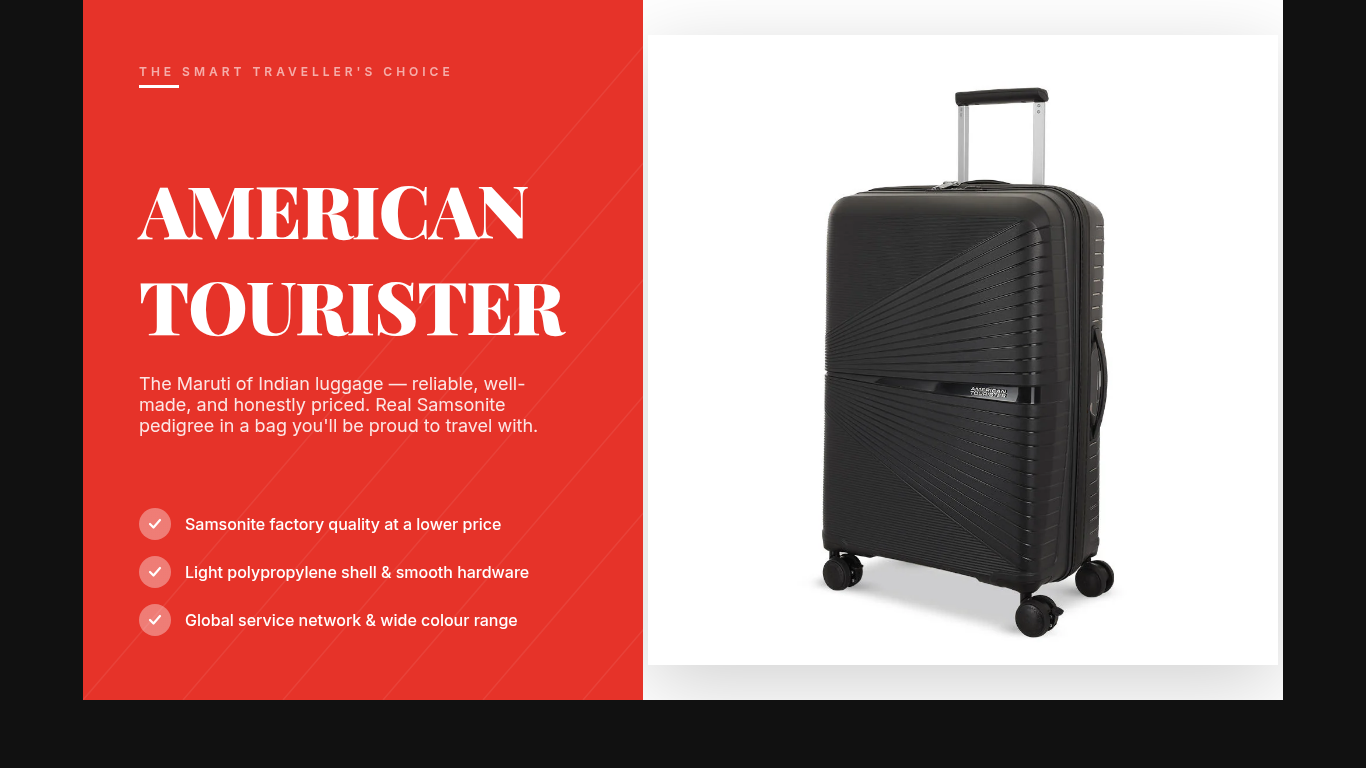
An American Tourister’s real home is the middle of the market — and for a great many Indian travellers, the middle is exactly the right place to be.