Mokobara Luggage Review: Is the Hype Worth the Price?
No Indian luggage brand of the last five years has generated as much noise as Mokobara. It arrived with clean silhouettes, named colourways, Japanese wheels, a six-year warranty, and a design language so consistent that the Indian press started calling it “the Apple of luggage.” It made a hard-shell cabin feel like a lifestyle object rather than a commodity — and it made a lot of young professionals decide their first “proper” suitcase should be a Mokobara. At roughly ₹9,500 for a cabin bag, though, it also costs about double what a perfectly good polycarbonate trolley from Safari does.
So this review asks the only question that matters once you’ve admired the photos: is the hype worth the price? We look at what the flagship Iconic Cabin is actually built from, what the warranty and the famous in-box extras really give you, and — crucially — what the premium over cheaper polycarbonate rivals is buying, and what it isn’t. The answer is more nuanced than either the fan reviews or the backlash suggests.
The short answer: Mokobara is a genuinely premium, beautifully finished, thoughtfully equipped cabin bag — and the hype is largely earned on design, hardware, and the ownership experience. But you are paying for finish, brand, and extras, not for a shell that outperforms: it’s the same polycarbonate material class rivals use for half the price, it’s glossy (so it scuffs), and at 3.27 kg it’s not light. Worth it if you want a design-led lifestyle object; not if you want pure value or the toughest, longest-warranty shell.
KEY TAKEAWAYS
- Mokobara is the Indian D2C brand that created “design-led luggage” as a category — founded 2020, its cabin was designed with London studio Morrama, and it’s often called “the Apple of luggage.”
- The flagship Iconic Cabin is ~₹9,500 (MRP ₹11,999): German Makrolon polycarbonate shell, Japanese Hinomoto silent wheels, TSA keyless lock, YKK zips, and a USB pass-through pocket.
- In-box extras lift the experience: a “magic eraser” for scuffs, a dust cover that doubles as a laundry bag, optional personalisation, and a 30-day full-refund trial.
- Warranty is 6 years on the Iconic, Access & Em ranges (3 on Transit; 12 months on bags) — manufacturing defects only, India-only for replacement, handled mail-in with no walk-in service network.
- The premium buys design, finish, and experience — not materials that outperform: the shell is still polycarbonate (rivals use it for ~half), it’s glossy and scuffs, it’s ~3.27 kg against the 7 kg cabin cap, and the Hinomoto wheels are fixed, not replaceable.
- Despite the Indian-brand image, production spans several Asian countries.
1. Mokobara: The Brand That Turned Luggage Into a Lifestyle Object
Founded in 2020 by Praveen Elavia and Sangeeta Jha, Mokobara set out to do something the Indian luggage shelf had never really attempted: treat a suitcase as a considered design object rather than a grey box with wheels. It worked with the London design studio Morrama, built a tight, coherent line around a recognisable grooved silhouette and named colourways — Happy Green, Tailored Blue, Money Moves Sunray — and marketed it with the polish of a consumer-tech brand. Indian press duly filed it as “the Apple of luggage,” and the label stuck because the positioning is that deliberate.
The strategy created a category. Mokobara made a design-led cabin bag feel like the default first proper suitcase for a young urban professional, and it backed the image with substance — a six-year warranty, Japanese Hinomoto wheels, and a co-branded “Moko 6E” cabin release tied to IndiGo’s 6E flights. The range now spans cabin and check-in trolleys, backpacks, duffels, totes, and packing organisers, all speaking the same visual language. Whatever you conclude about the price, Mokobara genuinely built the design-first luggage segment in India — everyone else in this space is, to some degree, responding to it.
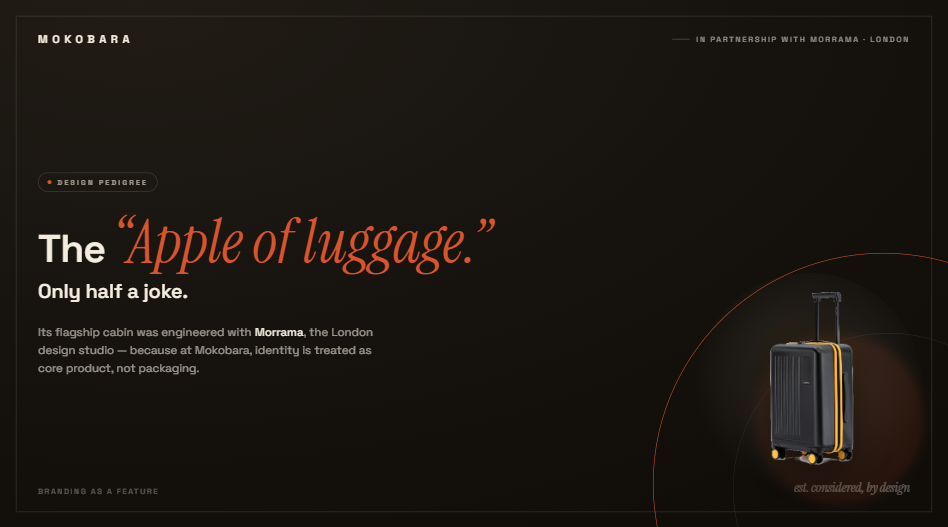
FUN FACT: Mokobara’s flagship cabin was developed with Morrama, a London design studio, and the brand takes its identity so seriously — down to a raccoon mascot and “the occasional raccoon GIF” in its emails — that the “Apple of luggage” nickname is only half a joke. It even ran a co-branded cabin with IndiGo, the “Moko 6E,” tied to the airline’s 6E flight code. Few luggage brands anywhere treat branding as a core product feature the way Mokobara does.
2. Understanding the Mokobara Range
Mokobara’s line is narrower and more disciplined than a legacy brand’s, which is part of the appeal — but the ranges do sit at different price and warranty levels, and knowing them matters. The Iconic range is the flagship, with the fullest feature set and the six-year warranty. Access and Em are alternate design lines at similar coverage, while the cheaper Transit range is the value entry point at a shorter three-year warranty. Here is how the line breaks down.
| Range | Type | Material | Best For | Price (sale) |
|---|---|---|---|---|
| Transit | Hardside cabin / check-in | German Makrolon PC | Entry into the brand, value-conscious | ₹5,000–₹8,000 |
| Iconic (The Cabin / Check-in) | Hardside, TSA, USB pocket | German Makrolon PC | Flagship design-led travel | ₹9,500–₹13,500 |
| Access / Em | Hardside spinner | German Makrolon PC | Alternate design lines | ₹8,000–₹13,000 |
| Cabin Pro | Hardside cabin, front pocket | German Makrolon PC | Business & tech travellers | ₹13,000–₹15,000 |
| Backpacks & duffels | Backpack / duffel | Fabric | Everyday and weekend | ₹3,000–₹8,000 |
| Organisers & totes | Packing organiser / tote | Fabric | Organisation, add-ons | ₹1,000–₹7,000 |
Prices listed are indicative and were accurate at the time of research. Luggage and bag prices fluctuate frequently due to sales, festive discounts, and MRP-vs-street-price gaps, so actual prices at the time of your purchase may differ from what’s listed here. Always verify current pricing on the retailer’s website before buying.
3. The Trolleys: What the Hype Is Built On
The heart of the brand is the Iconic Cabin, and on the hardware sheet it delivers. This is a properly specified premium trolley, and much of the hype is built on details that are genuinely good rather than merely marketed.
Materials and construction
The shell is German Makrolon polycarbonate — flexible, impact-resistant, and water-resistant, with groove details that add rigidity. The wheels are the star: Japanese Hinomoto silent spinners that genuinely glide more quietly and smoothly across airport flooring than most rivals, and which Mokobara names explicitly as a quality signal. You also get a one-push TSA-approved keyless lock, YKK zips, an inbuilt compression system, and on the Iconic Cabin a USB pass-through pocket to route a cable from your own power bank (no battery is included). Two honest caveats: the glossy shell attracts scuffs and scratches, and at 3.27 kg empty the cabin is not ultralight — that weight eats into the 7 kg Indian cabin cap faster than some buyers expect.
What the 6-year warranty actually covers
Mokobara offers 6 years on the Iconic, Access, and Em luggage ranges, 3 years on the cheaper Transit range, and 12 months on bags, backpacks, and select totes — the exact term depends on the range, a distinction the brand publishes on its FAQ. Cover is repair or replacement of manufacturing defects and excludes normal wear and tear. Two things to note: replacement is India-only (international buyers get a refund path, not global servicing), and claims are handled directly by Mokobara on a mail-in basis — there is no walk-in service network like Samsonite’s or Safari’s. On the plus side, every bag comes with a 30-day full-refund trial, extendable to 100 days via a paid Moko Club membership.
4. The Price Question: What You’re Actually Paying For
Here is the crux. At around ₹9,500, the Iconic Cabin costs roughly double a polycarbonate Safari Thorium with a TSA lock, and more than an entry Samsonite — which carries a 10-year warranty to Mokobara’s 6. So what does the premium actually buy? Design and finish, first: Mokobara’s is the cleanest, most consistent look in the Indian market, and if you want a bag that looks considered, nothing at this price matches it. Second, hardware and experience: the Hinomoto wheels, the YKK zips, the magic eraser, the compression system, the personalisation, and the 30-day trial add up to an ownership experience that feels genuinely premium.
What the premium does not buy is a shell that outperforms. German Makrolon is good polycarbonate — but it is still polycarbonate, the same material class Safari, Mokobara, and Samsonite use, often for much less. The glossy finish scuffs, the 3.27 kg weight is on the heavy side, the Hinomoto wheels are fixed rather than replaceable (newer rivals like NORI offer pop-out wheels and a built-in weight indicator at the same price), and despite the Indian-brand image, production spans several Asian countries. The premium is real value if you want design; it is poor value if you want the toughest or lightest shell per rupee.
THE REAL PICTURE: Mokobara is a “want,” not a “need” — and that’s a legitimate thing to buy. The premium over a Safari Thorium isn’t buying you a tougher shell; both are polycarbonate that will survive the airport-to-hotel arc for years. It’s buying you the best-looking bag on the belt, hardware that feels lovely to use, a thoughtful set of extras, and a brand you enjoy owning — the same reasons people pay more for a considered phone or a nice watch. If that matters to you, the hype is worth it. If you measure luggage in rupees-per-litre or years-of-warranty, cheaper rivals win on paper, and Mokobara will look overpriced. Both readings are correct; they’re just answering different questions.
5. Who Should Buy Mokobara
-
Buy it if: you want a design-led cabin that looks considered and premium, you value the ownership experience (Hinomoto wheels, extras, 30-day trial), and you’re happy to pay for finish and brand rather than raw specs.
-
The Iconic Cabin is the pick if: you want the full feature set — 6-year warranty, USB pass-through, best finish — and the flagship price doesn’t deter you.
-
Consider the Transit range if: you want the look for less and can accept the shorter 3-year warranty and fewer extras.
-
Look elsewhere if: you want maximum value per rupee (Safari Thorium), the longest warranty and a walk-in service network (Samsonite), the lightest shell, replaceable wheels or a weight indicator (NORI), or luggage made entirely in India.
6. Verdict
Mokobara earned its hype. It created the design-led luggage category in India, and its flagship cabin genuinely delivers on the things it promises — a clean, distinctive shell, lovely Hinomoto wheels, a proper TSA lock and YKK zips, a thoughtful set of extras, and a six-year warranty wrapped in the best ownership experience in the segment. As a considered object you’ll enjoy owning for years, it is one of the cleanest picks on the shelf, and the fan enthusiasm is not misplaced.
But “worth the price” depends entirely on what you’re buying it for. The premium over a Safari or an Uppercase isn’t buying a tougher or lighter shell — it’s the same polycarbonate class, glossier and a little heavier, with fixed wheels and mail-in-only warranty service. What it’s buying is design, finish, and delight. If those are worth paying for — and for a lot of buyers they genuinely are — Mokobara is worth every rupee. If you judge luggage purely on specs and value, the honest answer is that you can get the same protection for less, and the hype is something you’re paying a premium to enjoy.